

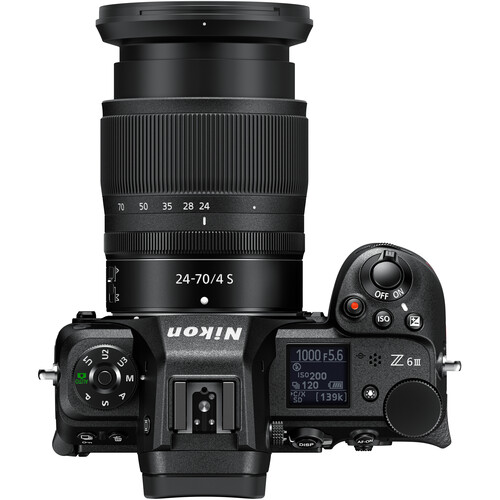
- Top continuous shooting speeds of 20 fps when shooting in raw, up to 60 fps when shooting in full-frame JPEG, and 120 fps when shooting JPEGs using a DX crop, with all rates supporting full AF/AE performance.
- Able to buffer over 1000 images in a burst when using the electronic shutter, meaning image sequences can be recorded for approximately 50 seconds continuously.
- Pre-Release Capture at up to 120 fps helps make decisive moment shots easier by recording frames in a burst for up to a second prior to actually releasing the shutter. When this feature is activated, burst shooting will commence when the shutter is half-pressed and the buffer will retain up to 4 seconds’ worth of frames after fully pressing the shutter.
- Electronic shutter affords a top shutter speed of 1/16,000 sec for working in the brightest conditions with wider apertures.
- Partially-stacked sensor design reduces rolling shutter distortion so fast-moving subjects, like a golf club, tennis racket, or baseball bat, do not appear distorted when working with shutter speeds up to 1/16,000 sec.
- AF calculations are done at a 120 fps rate to keep up with fast continuous shooting speeds.
Utilizing inherited algorithms and deep learning technology from the Z9, including sophisticated Subject Detection, the Z6 III can recognize a variety of distinct subject types, ranging from humans to animals to airplanes to bicycles. When working in Auto-Area AF, these subjects will automatically be detected, focused on, and tracked to ensure sharp focus when the subject is moving across the frame.
Eye-Detection AF, specifically, has been tuned for improved accuracy and refined recognition of eyes in the scene and can also be used in conjunction with custom Wide-Area AF for different subject shapes and sizes.
Perfect for portraits, the Z6 III improves on the partially-stacked sensor’s inherent capabilities with a series of processing tools and shooting functions to improve portraits:
- Portrait mode processes portraits for skin with natural texture and a rounded feel
- Rich Tone Portrait mode, a picture mode that produces more vivid results while capturing details of the subject’s complexion and avoiding loss of detail in the highlights
- Flat Monochrome mode features gentle gradations from highlights to shadows, producing soft monochrome portraits
- Deep Tone Monochrome mode chooses slightly darker tones in the range from shadows to mid-tones, with brightness rapidly increasing as tones progress from mid-tones to highlights
- Skin softening can be used on up to three subjects in a shot and slightly blurs the skin for a more pleasing texture while still retaining essential sharpness on eyes and hair
- Manual white balance control is more intuitive when making adjustments and Auto WB has also been optimized for human subjects
- Take full advantage of Nikon’s portrait modes by pairing the Z6 III with one of Nikon’s portrait Z lenses, like the 50mm f/1.2 S, the 85mm f/1.2 S, or the 135mm f/1.8 S Plena
Equally capable for video, the Z6 III approaches the Z9’s recording capabilities here, as well, with a variety of resolutions and frame rates available up to 6K.
Using full pixel readout, 6K60p video can be recorded with continuous shooting, while 4K and Full HD recording is also possible in a variety of frame rates, including full-frame 4K recording at up to 120p and Full HD recording at 240p for slow-motion playback.
Internal 12-bit raw raw recording at up to 6K 60p in the N-RAW format is supported along with internal ProRES RAW HQ. Raw recording offers greater tonal and color latitude and can improve dynamic range, benefitting color grading needs and post-production flexibility.
- N-RAW is Nikon’s own raw recording format that offers impressively small file sizes compared to other raw formats as well as the ability to create MP4 proxies for more efficient previewing or transferring.
- N-RAW recording is available at up to 6K at 60p and ProRes RAW is also available at up to 6K and 30p.
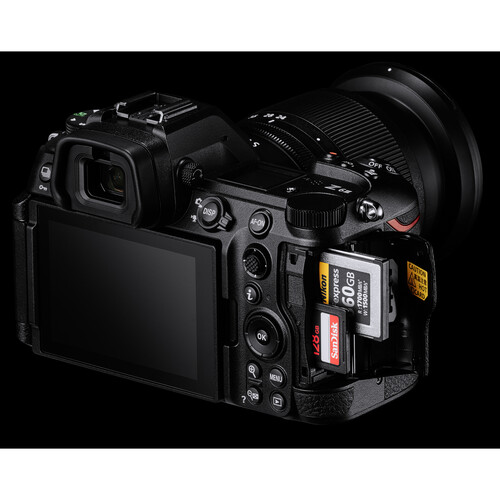
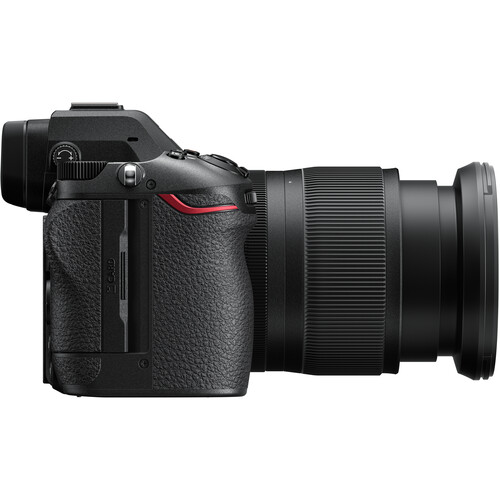
- Dual card slots-one CFexpress Type B slot and one UHS-II SD slot-allow for flexible file saving. The CFx slot is suitable for data-intensive applications, like 6K recording and high-speed burst shooting, while the SD slot retains compatibility with the popular storage format. Additionally, the CFx B slot is also compatible with XQD memory cards.
- Pair the Z6 III with the optional MB-N14 Power Battery Pack grip for improved ergonomics when shooting vertical and up to 1.9x the battery life.
- The smaller, lighter design makes the Z6 III an ideal candidate for rigging or use on a gimbal for video use.
- Premium weather sealing protects against dust and moisture for confident use in harsh climates.
- In-body Vibration Reduction, Nikon’s image stabilization system, now supports Synchro VR to achieve up to 8 stops of camera shake compensation when used with select Z lenses.
Matching the professional build quality, the Z6 III is fitted with a variety of connectivity options to suit various workflow needs:
- Another Nikon first, the Z6 III features direct-to-cloud connectivity with Nikon Imaging Cloud for file transfer and access to Nikon’s imaging recipes for creative color grading
- Sync timecodes using Ultrasync Blue from Atmos, connecting multiple Z6 III camera bodies for multi-camera production setups
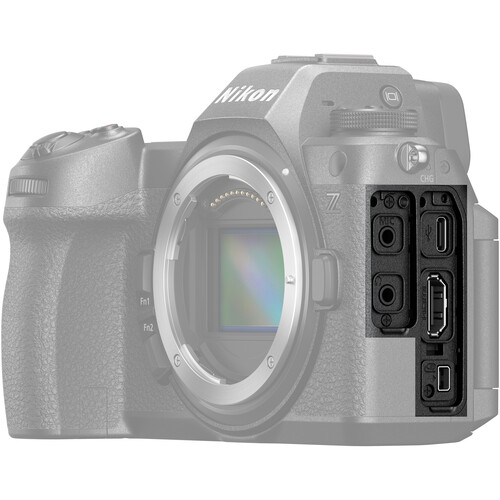
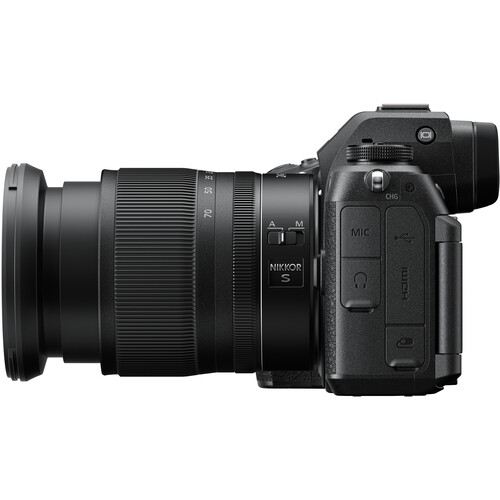
- Full-size HDMI port for outputting video to an external recorder or monitor
- 3.5mm headphone port and a new line-in port for on-board audio monitoring and high-quality audio input directly into the camera
- One USB-C port that supports file transfers and tethering as well as power delivery and battery charging
- USB-C communication terminal supports USB-LAN connectivity when paired with an optional USB-C to Ethernet adapter. This enables a 1000BASE-T wired LAN connection for transferring files over FTP
- 10-pin port offers wide accessories and remote connectivity
- Bluetooth and Wi-Fi (2.4 and 5 GHz) permit wireless transferring of files, remote camera control via a mobile device, and works in conjunction with the NX Mobile Air app for file management
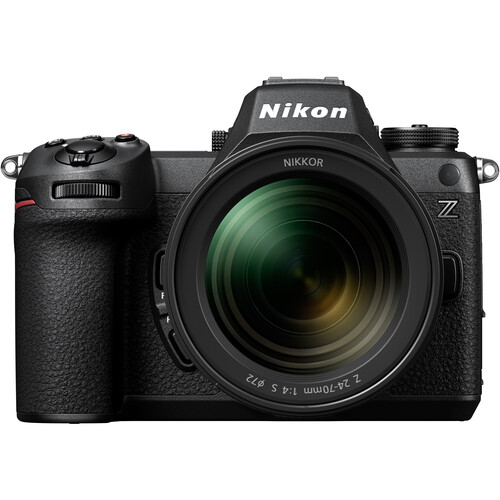
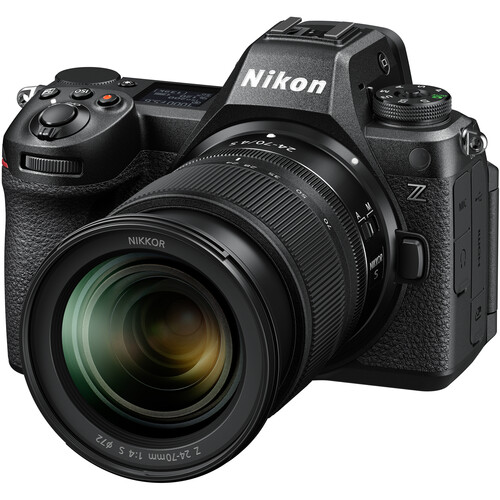
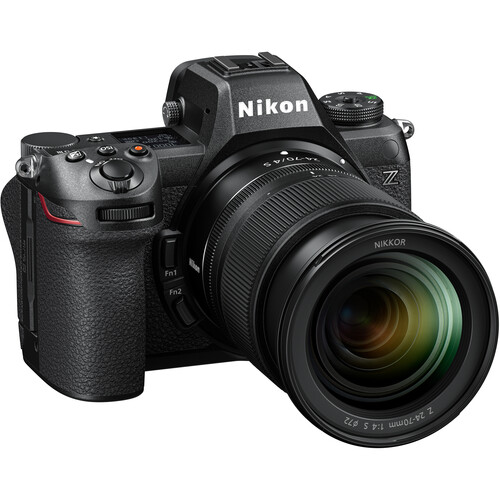
Covering a useful range of focal lengths, the NIKKOR Z 24-70mm f/4 S is a versatile zoom, spanning wide-angle to portrait-length perspectives. Its constant f/4 maximum aperture maintains a consistent exposure throughout the zoom range and also helps to realize a more compact and lightweight alternative to an f/2.8 zoom. In regard to the optical design, a unique aspherical extra-low dispersion element, in addition to three aspherical elements, is used to help reduce chromatic aberrations and distortions throughout the zoom range in order to achieve high image sharpness and clarity. Both Nano Crystal and Super Integrated Coatings have also been applied to control flare and ghosting for greater contrast and color rendering in bright and backlit conditions.
Complementing the optics, a stepping motor provides quick, quiet, and precise autofocus performance along with full-time manual focus override to suit both stills and video applications. A programmable control ring can be set for intuitive adjustment over a variety of camera and exposure settings. Additionally, the lens has a button-less retractable barrel to realize a more compact form factor when not in use.
Nikon Z6 III Specs
| Lens Mount | Nikon Z |
| Sensor Resolution | Actual: 26.79 Megapixel Effective: 24.5 Megapixel (6048 x 4032) |
| Image Sensor | 35.9 x 23.9 mm (Full-Frame) Partially Stacked CMOS |
| Sensor Crop (35mm Equivalent) | Crop Factor: 1x *Additional Crop Occurs in Select Video Modes |
| Image Stabilization | Sensor-Shift, 5-Axis |
| Built-In ND Filter | No |
| Capture Type | Stills & Video |
| Shutter Type | Mechanical Focal Plane Shutter and Electronic Rolling Shutter |
| Shutter Speed | Mechanical Shutter 1/8000 to 15 Minutes Electronic Shutter 1/16000 to 15 Minutes |
| Bulb/Time Mode | Bulb & Time Mode |
| ISO Sensitivity Range | Photo 100 to 64,000 (Extended: 50 to 204,800) Video 100 to 51,200 |
| Metering Method | Center-Weighted Average, Highlight Weighted, Matrix, Spot |
| Exposure Modes | Aperture Priority, Auto, Manual, Program, Shutter Priority |
| Exposure Compensation | -5 to +5 EV (1/3, 1/2 EV Steps) |
| Metering Range | -4 to 17 EV |
| White Balance | 2500 to 10,000K Presets: Auto, Cloudy, Color Temperature, Direct Sunlight, Flash, Fluorescent, Incandescent, Shade |
| Continuous Shooting | Up to 20 fps at Maximum Resolution |
| Interval Recording | Yes |
| Self-Timer | 2/5/10/20-Second Delay |
| Aspect Ratio | 1:1, 3:2, 16:9 |
| Image File Format | HEIF, JPEG, Raw |
| Bit Depth | 14-Bit |
| Internal Recording Modes | ProRes RAW/ProRes RAW HQ/Raw 6048 x 3404 at 23.98/25/29.97/50/59.94 fps 4032 x 2268 at 23.98/25/29.97/50/59.94 fps 3984 x 2240 at 23.98/25/29.97/50/59.94/100/120 fps H.264/H.265 8/10-Bit 5376 x 3024 at 23.98/25/29.97/50/59.94 fps UHD 4K (3840 x 2160) at 23.98/25/29.97/50/59.94/100/120 fps 1920 x 1080 at 23.98/25/29.97/50/59.94/100/120/200/240 fps |
| External Recording Modes | HDMI UHD 4K (3840 x 2160) |
| Fast-/Slow-Motion Support | Slow-Motion Only |
| Gamma Curve | HDR-HLG, Nikon N-Log |
| Recording Limit | Up to 125 Minutes |
| IP Streaming | No |
| Built-In Microphone | Stereo |
| Audio Recording | 16-Bit 48 kHz AAC Audio 2-Channel 24-Bit 48 kHz LPCM Audio |
| Media/Memory Card Slot | Slot 1: CFexpress Type B / XQD Slot 2: SD/SDHC/SDXC (UHS-II) |
| Video I/O | 1x HDMI Output |
| Audio I/O | 1x 1/8″ / 3.5 mm TRS Stereo Headphone Output 1x 1/8″ / 3.5 mm TRS Stereo Microphone Input |
| Power I/O | 1x USB-C Input |
| Other I/O | 1x USB-C Data Output (Shared with Power Input) 1x Nikon DC2 Data Input |
| Wireless | 2.4 / 5 GHz Wi-Fi 5 (802.11ac), Bluetooth 5.0 |
| Mobile App Compatible | Yes: Android & iOS App Name: Nikon Imaging Cloud Functionality: Access Stored Files, Firmware Update |
| Global Positioning (GPS, GLONASS, etc.) | GPS *Via Connected Smartphone |
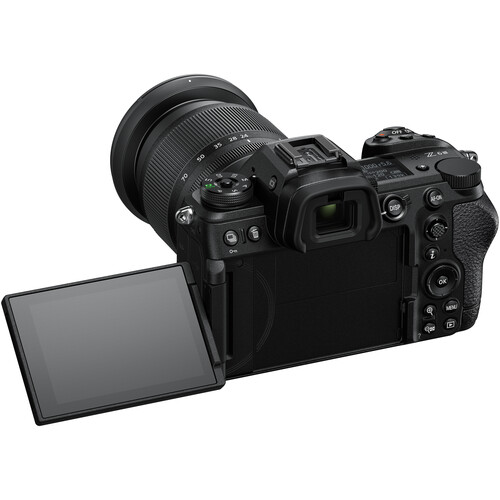
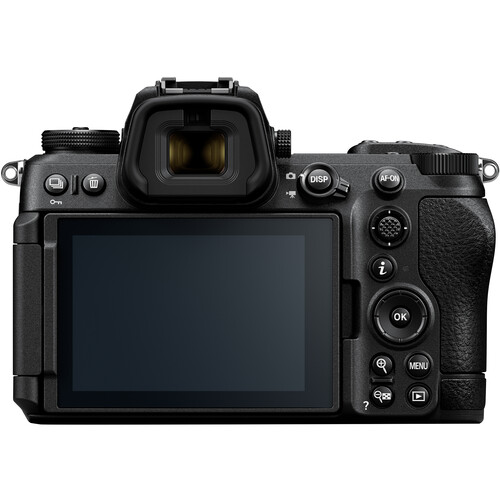
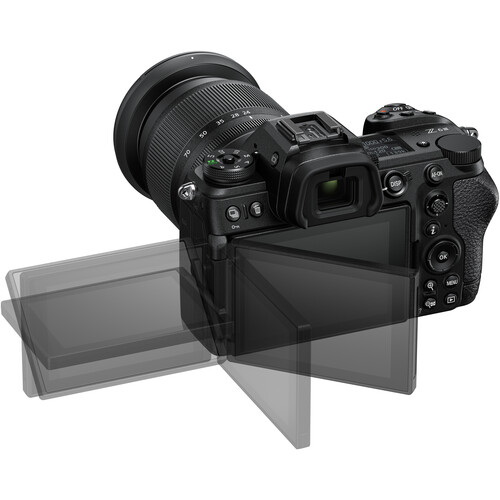
| Display Size | 3.2″ |
| Resolution | 2,100,000 Dot |
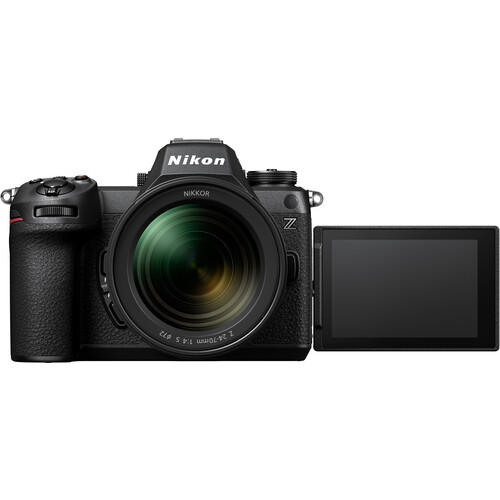
| Display Type | Articulating Touchscreen LCD |
| Secondary Display | Top: Status Display |
| Type | Built-In Electronic |
| Size | 0.5″ |
| Resolution | 5,760,000 Dot |
| Eye Point | 21 mm |
| Coverage | 100% |
| Magnification | Approx. 0.8x |
| Diopter Adjustment | -4 to +2 |
| Focus Type | Auto and Manual Focus |
| Focus Mode | Continuous-Servo AF, Full-Time Servo, Manual Focus, Single-Servo AF |
| Autofocus Points | Photo, Video Contrast Detection, Phase Detection: 299 |
| Autofocus Sensitivity | -10 to +18 EV |
| Built-In Flash/Light | No |
| Flash Modes | First-Curtain Sync, Off, Rear Curtain/Slow Sync, Rear Sync, Red-Eye Reduction, Slow Sync, Slow Sync/Red-Eye Reduction |
| Maximum Sync Speed | 1/200 Second |
| Flash Compensation | -3 to +1 EV (1/3, 1/2 EV Steps) |
| Dedicated Flash System | TTL |
| External Flash Connection | Shoe Mount |
| Battery Type | 1x EN-EL15c Rechargeable Lithium-Ion (Approx. 360 Shots) |
| Shoe Mount | 1x Hot Shoe |
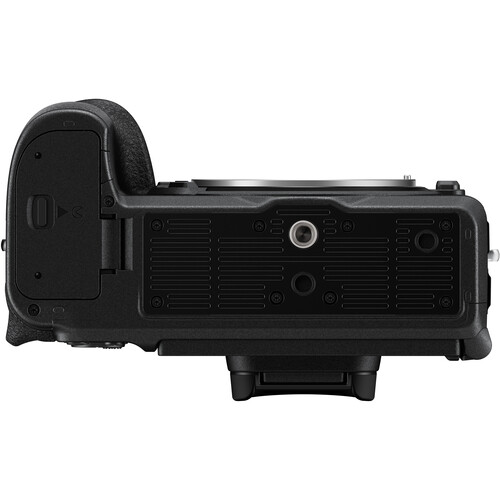
| Tripod Mounting Thread | 1x 1/4″-20 Female (Bottom) |
| Material of Construction | Magnesium Alloy |
| Operating Conditions | 32 to 104°F / 0 to 40°C up to 85% Humidity |
| Dimensions (W x H x D) | 5.5 x 4 x 2.9″ / 138.5 x 101.5 x 74 mm |
| Weight | 23.6 oz / 670 g (Body Only) |
Nikon 24-70mm f/4 Specs
| Maximum Aperture | f/4 |
| Minimum Aperture | f/22 |
| Lens Mount | Nikon Z |
| Lens Format Coverage | Full-Frame |
| Angle of View | 84° to 34° 20′ |
| Minimum Focus Distance | 11.81″ / 30 cm |
| Maximum Magnification | 0.3x |
| Optical Design | 14 Elements in 11 Groups |
| Diaphragm Blades | 7, Rounded |
| Focus Type | Autofocus |
| Image Stabilization | No |
| Filter Size | 72 mm (Front) |
| Dimensions (ø x L) | 3.05 x 3.48″ / 77.5 x 88.5 mm |
| Length at Maximum Extension | 5.44″ / 138.2 mm |
| Weight | 1.1 lb / 500 g |
 EN
EN
Reviews
There are no reviews yet.